


Tap into existing downstream gfci outlet for new fan in show stall
My bathroom has a separate toilet room in it and the exhaust fan is in that toilet room. It does not do a very good job of venting the steam from the shower. Additionally, the shower does not get much light from the the vanity lights so it is a bit dark in the stall.
I want to install another exhaust fan directly over the shower with a built in light to address both issues.
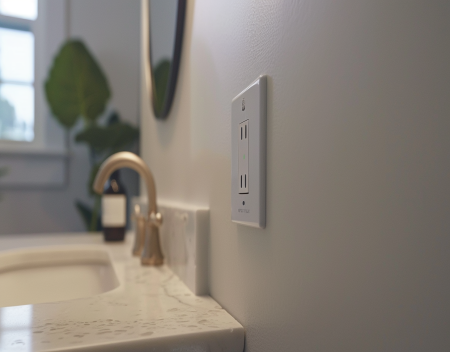
There is a single outlet in the bathroom and it is downstream from the gfci outlet.
I would like to tap the line going to that outlet in the attic and run it to a new switch for the fan.
Is this the proper / common way?
I am assuming that all the down streams outlets are wired in series. Is it ok to add this switch / fan in parallel?
Below is the wiring diagram from a fan I was considering. Would I just run the tapped line from the attic down the inside of the wall to the switch and then back up into the attic and to the fan?
Obviously I am new to home wiring but I don't feel like this is that big of a project. Please help a beginner out with any other points I have not considered.
Question from user Dennis_M at stackexchange.
Answer:
The basic concept is fine. You should make sure that the exhaust fan/light is rated for a wet location.
As far as serial vs. parallel: AC electric connections are technically wired in parallel but logically wired in a tree. A tree can be a single branch - which looks like serial. Or it can have one root with many branches - which looks like parallel. But the hot wires are all together electrically and the neutral wires are all together electrically, which is parallel. Nothing special to do that - just always connect hots together and neutrals together and it works just fine. The one key exception is GFCI where there is an "in" or "line" or "supply", both hot and neutral, and an "out" or "load", both hot and neutral. That needs to be identified and connected correctly so that the "load" devices are protected.
I recommend running 3-wire cable (a.k.a., /3) - black/red/white (plus bare ground but that doesn't factor into the numbering scheme) from the switch to the fan/light. That way you can have two separate switches in the same box, one for the light and the other for the fan.
Answer from user manassehkatz-Moving 2 Codidact at stackexchange.
My bathroom has a separate toilet room in it and the exhaust fan is in that toilet room. It does not do a very good job of venting the steam from the shower. Additionally, the shower does not get much light from the the vanity lights so it is a bit dark in the stall.
I want to install another exhaust fan directly over the shower with a built in light to address both issues.
There is a single outlet in the bathroom and it is downstream from the gfci outlet.
I would like to tap the line going to that outlet in the attic and run it to a new switch for the fan.
Is this the proper / common way?
I am assuming that all the down streams outlets are wired in series. Is it ok to add this switch / fan in parallel?
Below is the wiring diagram from a fan I was considering. Would I just run the tapped line from the attic down the inside of the wall to the switch and then back up into the attic and to the fan?
Obviously I am new to home wiring but I don't feel like this is that big of a project. Please help a beginner out with any other points I have not considered.
Question from user Dennis_M at stackexchange.
Answer:
The basic concept is fine. You should make sure that the exhaust fan/light is rated for a wet location.
As far as serial vs. parallel: AC electric connections are technically wired in parallel but logically wired in a tree. A tree can be a single branch - which looks like serial. Or it can have one root with many branches - which looks like parallel. But the hot wires are all together electrically and the neutral wires are all together electrically, which is parallel. Nothing special to do that - just always connect hots together and neutrals together and it works just fine. The one key exception is GFCI where there is an "in" or "line" or "supply", both hot and neutral, and an "out" or "load", both hot and neutral. That needs to be identified and connected correctly so that the "load" devices are protected.
I recommend running 3-wire cable (a.k.a., /3) - black/red/white (plus bare ground but that doesn't factor into the numbering scheme) from the switch to the fan/light. That way you can have two separate switches in the same box, one for the light and the other for the fan.
Answer from user manassehkatz-Moving 2 Codidact at stackexchange.