


GFCI receptacles vs GFCI breaker - Can my kitchen receptacles be standard receptacles?
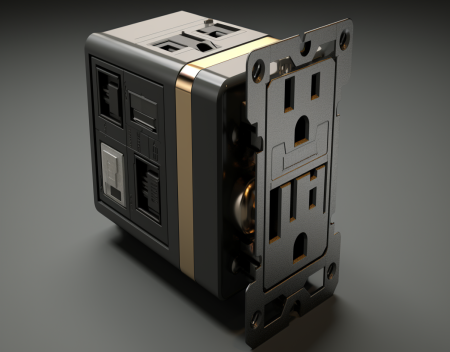
It is my understanding that most (if not all?) receptacles near wet locations (e.g. kitchens, bathrooms, etc.) need to be "GFCI" per the NEC. does this just mean GFCI protected? In other words, can all of my outlets in my kitchen be standard outlets IF the breakers in the panel for those circuits are GFCI-rated? And, if so, will this pass inspection or are do inspectors tend to prefer one way over the other?
Specifically, my use case here requires a duplex receptacle (under my kitchen sink) to be half-switched: one (always power) for my insta-hot water heater and one for my (switched) disposal. Because this outlet is 'near water', it needs to be "GFCI". But I don't believe I can split the conduction/break the tab of a GFCI outlet (thus creating the half- perm. power; half-switched).
Question from user WaffleTacos at stackexchange
Answer:
Code requires GFCI protection. It doesn't specify whether each outlet has to be "GFCI". In fact, you can have GFCI protection of "plain" outlets by connecting them as load to GFCI outlet.
Thus, it doesn't matter whether your outlet is GFCI or GFCI-protected at the level of breaker. The problem is that you will have to run outside / find your panel and manually reset GFCI. This is bad if your garbage disposal is tripping GFCI, someone sticks their hand in disposal, you reset GFCI at the panel, someone is losing their hand.
Answer from user aaaaa says reinstate Monica at stackexchange
It is my understanding that most (if not all?) receptacles near wet locations (e.g. kitchens, bathrooms, etc.) need to be "GFCI" per the NEC. does this just mean GFCI protected? In other words, can all of my outlets in my kitchen be standard outlets IF the breakers in the panel for those circuits are GFCI-rated? And, if so, will this pass inspection or are do inspectors tend to prefer one way over the other?
Specifically, my use case here requires a duplex receptacle (under my kitchen sink) to be half-switched: one (always power) for my insta-hot water heater and one for my (switched) disposal. Because this outlet is 'near water', it needs to be "GFCI". But I don't believe I can split the conduction/break the tab of a GFCI outlet (thus creating the half- perm. power; half-switched).
Question from user WaffleTacos at stackexchange
Answer:
Code requires GFCI protection. It doesn't specify whether each outlet has to be "GFCI". In fact, you can have GFCI protection of "plain" outlets by connecting them as load to GFCI outlet.
Thus, it doesn't matter whether your outlet is GFCI or GFCI-protected at the level of breaker. The problem is that you will have to run outside / find your panel and manually reset GFCI. This is bad if your garbage disposal is tripping GFCI, someone sticks their hand in disposal, you reset GFCI at the panel, someone is losing their hand.
Answer from user aaaaa says reinstate Monica at stackexchange