


GFCI on an induction range?
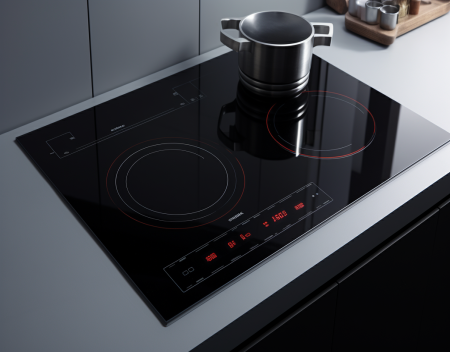
Based on my reading, NEC2023 says that if a stove is within 6 feet of the edge of a kitchen sink then the stove needs to be GFCI protected.
Modern induction ranges pull 50 amps and (usually) need their own, dedicated, circuit out of the electric panel in the house. This dedicated circuit comes with a dedicated outlet and dedicated power wire.
My kitchen isn't big enough to move a freestanding range more than 6 feet away from the edge of the sink. Is it accurate, then, that that the only proper way to install the wiring to power an induction range would be to use a GFCI breaker in the panel?
Question from user THill3 at stackexchange
Answer:
Assuming you're on NEC2020 or up, yes, a GFCI is now required in a kitchen on a 250V circuit in many or all circumstances. Here's my favorite Eaton chart on the matter.
For NEC 2020, the triggering requirement is the outlet being within six feet of the edge of a sink. Do note the code says in 210.8:.
'For the purposes of this section, the distance from receptacles shall.
be measured as the shortest path the power supply cord connected to.
the receptacle would follow without piercing a floor, wall, ceiling,.
or fixed barrier.'.
So you don't have to beeline the six feet. A freestanding range can be closer than 6 feet to the sink so long as the receptacle itself is further away than that. Heck, if it's close to working, you could add a splash barrier between the range and the sink to buy yourself more distance.
This might mean purchase of an expensive 50A GFCI breaker. Or if you're running a new circuit, it might mean making sure that the receptacle is six feet away from the edge of the sink.
Once you're on NEC 2023, you need the GFCI no matter what. 210.8 now says.
GFCI protection shall be provided for the branch circuit or outlet.
supplying the following appliances rated 150 volts or less to ground.
and 60 amperes or less, single- or 3-phase:.
Electric ranges.
Answer from user KMJ at stackexchange
Based on my reading, NEC2023 says that if a stove is within 6 feet of the edge of a kitchen sink then the stove needs to be GFCI protected.
Modern induction ranges pull 50 amps and (usually) need their own, dedicated, circuit out of the electric panel in the house. This dedicated circuit comes with a dedicated outlet and dedicated power wire.
My kitchen isn't big enough to move a freestanding range more than 6 feet away from the edge of the sink. Is it accurate, then, that that the only proper way to install the wiring to power an induction range would be to use a GFCI breaker in the panel?
Question from user THill3 at stackexchange
Answer:
Assuming you're on NEC2020 or up, yes, a GFCI is now required in a kitchen on a 250V circuit in many or all circumstances. Here's my favorite Eaton chart on the matter.
For NEC 2020, the triggering requirement is the outlet being within six feet of the edge of a sink. Do note the code says in 210.8:.
'For the purposes of this section, the distance from receptacles shall.
be measured as the shortest path the power supply cord connected to.
the receptacle would follow without piercing a floor, wall, ceiling,.
or fixed barrier.'.
So you don't have to beeline the six feet. A freestanding range can be closer than 6 feet to the sink so long as the receptacle itself is further away than that. Heck, if it's close to working, you could add a splash barrier between the range and the sink to buy yourself more distance.
This might mean purchase of an expensive 50A GFCI breaker. Or if you're running a new circuit, it might mean making sure that the receptacle is six feet away from the edge of the sink.
Once you're on NEC 2023, you need the GFCI no matter what. 210.8 now says.
GFCI protection shall be provided for the branch circuit or outlet.
supplying the following appliances rated 150 volts or less to ground.
and 60 amperes or less, single- or 3-phase:.
Electric ranges.
Answer from user KMJ at stackexchange