


Are there any arguments against LED strings for crawlspace lighting?
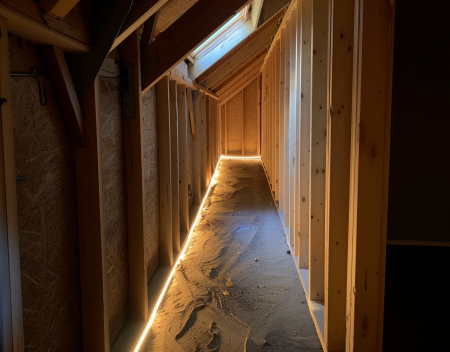
I have a small unfinished basement (1929 house) into which I regularly venture down (HVAC, electrical panel, IT, some food storage). The basement is surrounded by a dirt crawlspace and every time I get the chance, I look around for issues and anomalies. However, I am really frustrated by the darkness and grabbing a strong light every time and moving around is annoying. Also, often paths for the light rays are obstructed by duct work and beams.
I got two simple ceramic lamp holders and put on 6000 lumens LED lamps. While the light itself is good, I would need way more of them to reach behind duct work and beams.
From electrical perspective, I know GFCI is a requirement but bare bulbs themselves are allowed. My breaker for basement/crawlspace is GFCI+AFCI.
Now I got the idea to just use string lights. They are up to 24ft and can be extended (nearly) arbitrarily long. I could just add a simple switched receptacle and run the string light across the entire perimeter, just hanging with nails.
Sounds efficient, easy, cheap. Are there any possible issues to consider?
I am not sure about using an LED string or incandescent string. I would be leaning towards the LED version because it's more efficient and I believe more robust (hoping I do not have to venture into the crawl space often to replace bulbs).
Are there any arguments against LED strings?
Question from user divB at stackexchange.
Answer:
TL;DR LED.
Other than nostalgia - which sometimes has something going for it, but not for functional lighting in a crawlspace - there are really only 4 reasons for incandescent lighting instead of LED lighting:.
The original Easy Bake Oven, and some similar things that used a light bulb as a heating element.
Technical issues, typically where a single incandescent bulb in a fixture will prevent LEDs from blinking or having other problems.
Where you actually want the heat to help keep an area warm and/or dry - which is not terribly efficient but sometimes can make sense.
Inside ovens - LEDs don't like that much heat.
The example string lights you linked don't list lumens. But Googling replacement bulbs, I found pretty much what I expected:.
Incandescent = 11W per bulb, 40 lumens per bulb.
LED = 1W per bulb, 50 lumens per bulb.
In other words, the LED lights will provide about the same amount of light - maybe more - as the incandescent lights while using 1/10 (or less) of the electricity. YMMV, depending on quality of bulb.
Plus the LED bulbs will generally last much longer than equivalent incandescent bulbs, which is a bonus considering the hassle of replacing bulbs in a crawlspace.
Answer from user manassehkatz-Moving 2 Codidact at stackexchange.
I have a small unfinished basement (1929 house) into which I regularly venture down (HVAC, electrical panel, IT, some food storage). The basement is surrounded by a dirt crawlspace and every time I get the chance, I look around for issues and anomalies. However, I am really frustrated by the darkness and grabbing a strong light every time and moving around is annoying. Also, often paths for the light rays are obstructed by duct work and beams.
I got two simple ceramic lamp holders and put on 6000 lumens LED lamps. While the light itself is good, I would need way more of them to reach behind duct work and beams.
From electrical perspective, I know GFCI is a requirement but bare bulbs themselves are allowed. My breaker for basement/crawlspace is GFCI+AFCI.
Now I got the idea to just use string lights. They are up to 24ft and can be extended (nearly) arbitrarily long. I could just add a simple switched receptacle and run the string light across the entire perimeter, just hanging with nails.
Sounds efficient, easy, cheap. Are there any possible issues to consider?
I am not sure about using an LED string or incandescent string. I would be leaning towards the LED version because it's more efficient and I believe more robust (hoping I do not have to venture into the crawl space often to replace bulbs).
Are there any arguments against LED strings?
Question from user divB at stackexchange.
Answer:
TL;DR LED.
Other than nostalgia - which sometimes has something going for it, but not for functional lighting in a crawlspace - there are really only 4 reasons for incandescent lighting instead of LED lighting:.
The original Easy Bake Oven, and some similar things that used a light bulb as a heating element.
Technical issues, typically where a single incandescent bulb in a fixture will prevent LEDs from blinking or having other problems.
Where you actually want the heat to help keep an area warm and/or dry - which is not terribly efficient but sometimes can make sense.
Inside ovens - LEDs don't like that much heat.
The example string lights you linked don't list lumens. But Googling replacement bulbs, I found pretty much what I expected:.
Incandescent = 11W per bulb, 40 lumens per bulb.
LED = 1W per bulb, 50 lumens per bulb.
In other words, the LED lights will provide about the same amount of light - maybe more - as the incandescent lights while using 1/10 (or less) of the electricity. YMMV, depending on quality of bulb.
Plus the LED bulbs will generally last much longer than equivalent incandescent bulbs, which is a bonus considering the hassle of replacing bulbs in a crawlspace.
Answer from user manassehkatz-Moving 2 Codidact at stackexchange.